Markus Vinzent's Blog

Showing posts with label New Testament. Show all posts

Friday, 18 July 2025

New Testament for Dummies

 Together with a non-specialist, I am working towards a New Testament introduction for dummies (highly appreciated sort of non-academics!)


Here a first go - please let me know, if this is the right level of conversation:


B: It all sounds very exciting, exceedingly complex, and evidently intellectually and spiritually dynamic. A constant to and fro, it would seem, though evidently more competitive (between Marcion and the 'canonical party') than collaborative.


M: In truth, both: collaborative and competitive. Nothing extraordinary in that. Communication among academics has changed little since antiquity. They did then what we do now, learn from one another and attempt to make sense of the complexities.


B: The question for me is, what criteria governed the reworkings? Were they undertaken in close connection with trustworthy testimonies? Were they arbitrary, naïvely fanciful, or shrewdly devised?


M: Excellent questions. If I see things correctly, the revisions, much as today, tended to be conservative: only what seemed mistaken or imprecise was amended, and always in contact with what one held to be reliable testimony. Even fictive narratives (genre permitting, such as in the Acta literature or apocalyptic works) sought to remain within a tradition. The naïve ones are rare; calculating, deliberate alterations are more apt, often driven by purpose.


B: A distinguishing criterion seems to have been the attitude towards the Torah, which Marcion sought to exclude, while others strove to retain it at all costs.


M: This is a sensitive point, yet Marcion is no outlier here. Torah exegesis and even the development of new writings were commonplace in Jewish scholarly circles. The Jewish "Bible" was not yet a closed canon. Particularly the category of the "Writings," that third section of the Jewish Bible beyond Torah and Prophets, remained open.

We also have authors such as Philo of Alexandria, who interprets the Torah with great freedom, or Josephus, who in his Jewish Antiquities rewrites the entire Jewish scripture for a Hebrew-speaking and later also Greek audience. Many figures whom we designate as "Christian" (Ptolemaeus, Justin, and others) wrestle with which commands of the Torah remain binding, which are divine, Mosaic, or manmade, especially in light of the writings Marcion assembled.

No one insisted on retaining the Torah "at all costs", rather, it was maintained with considerable abridgement and qualification. Certainly, Marcion represents an extreme within this spectrum, viewing the Torah and the Prophets as wholly obsolete, and reinterpreting the Gospel and ten Pauline letters as Christ's new Torah, not as part of the third division of the Jewish scriptures, but as something altogether new.


B: But why multiply one Gospel into four? That seems to me to weaken rather than strengthen the case.


M: The first redactions of the single Gospel appear to have been uncoordinated, more reflective of the diversity of opinion among teachers of the time. All four canonical Gospels not only echo Marcion's text verbally and theologically, but also diverge from it, sometimes sharply.

In the very way they made use of Marcion's Gospel, so too did they utilise the Gospels developing alongside their own. The academic world then was no larger or smaller than now. They knew of one another, paid attention, copied and altered one another. This is no sign of weakness; it is the very nature of open scholarly discourse.


B: Perhaps it is best explained by positing multiple versions of Jesus' life, teaching, and death in circulation?


M: Perhaps, but not necessarily. The literary proximity and often-parallel structure of the five Gospels rather argues against it. Yet it seems that the various authors sought further information, added it when found, removed less fitting material, and restructured their texts.


B: You also mentioned Tatian, who compiled a single Gospel, presumably because he sensed that four versions were too vulnerable?


M: I would not leap to a polemical interpretation. Up to and even beyond Irenaeus, Gospel production appears to have followed the academic norms mentioned above. Teachers continued to produce Gospels: that of Mary, of Peter, and many more. When Bishop Serapion, around Irenaeus' time, encountered the Gospel of Peter in a congregation, he took no offence at its use, until he was alerted to controversies about it, whereupon he became critical.

That Tatian fused the five Gospels likely relates to the enduring influence of Marcion's Gospel within his New Testament, prompting Tatian to make a singular one of his own, as others may have attempted, as the Gospel of Peter fragment suggests.


B: Irenaeus, at any rate, comes close to recommending the modern canon.


M: Quite so. And just as the man who calls in the fire brigade may well have lit the blaze, so Irenaeus, with his propaganda tract, is likely the architect of the second canonical redaction, just as his teacher Polycarp may have stood behind the first canonisation of the Pauline letters.


B: If there was no "Luke," and Acts was not written by the same hand as the Gospel, then the linkage must be redactional, must it not?


M: Indeed. The Gospel of Luke, save for the additions and changes, is identical with Marcion's. The redactors adapted or composed Acts, furnishing it with a preface matching the one they appended to the Gospel in its revised form. The linguistic proximity of Luke and Acts is thus redactional, a feat still prompting scholars to treat the two as a unified work. In that sense, the redactors did their job well.


B: Finally, there is the "truth-question," which one might answer: it is of no consequence what historical-critical analysis may reveal; what was ultimately canonised is, by the Holy Spirit's inspiration, of unassailable authority.

This answer borrows the philosophical distinction between genesis and validity, only to transmute its meaning and apply it theologically. Yet in philosophy, this notion insists that historically contingent facts (a posteriori truths) cannot determine the validity of universally binding rational truths (a priori). The Pythagorean theorem is not true because Euclid discovered it in 300 BC; it is valid by virtue of pure reason, quite independently of its genesis.

To transfer this principle to theology is a daring methodological leap, a Salto mortale. Canonisation is not grounded in a priori insight, but rather constitutes a historical process of opinion-formation, even if one believes the Spirit guided it. Such guidance can never be proved a priori, only believed a posteriori, an act of human decision.


M: Faith, as Tertullian first expressed it, may entail such paradoxes: "What has Athens to do with Jerusalem?" Later: credo quia absurdum. To believe may be to perform one death-defying leap after another in the circus tent, a voluntary surrender. History is of little help here. For Irenaeus and Tertullian, the "canon of truth" outranks Scripture itself, though they argue with their opponents over which Scriptures are older. But that is not the point. The Holy Spirit in theology has no birth, no death, no age. It is a breath, and breath, as we know, cannot be pinned down.


B: So is the historical-critical method but a meaningless game of facts, I am not of the same opinion. I regard canonisation as fallible, even if the Spirit did assist. I conceive the relationship between God and humanity as dialogical, in which God allows errors, works with our limitations creatively, patiently, mercifully. This does not imply that all aspects of canonisation are wrong.


M: Indeed, the moment we add the supra-factual to the factual, be it breath, be it God, we change a critical method into one marked by indeterminacy, for we have introduced the incalculable into the equation.


B: But suppose you could demonstrate that certain redactional moves violated the historical truth of Jesus' teaching or Paul's, or even his Spirit, perhaps for reasons of power. Why should one not name and correct them?


M: We are far from that. We do not yet know what the "historical truth of Jesus’ teaching and life (or Paul’s)" is, nor what aligns with or contradicts his Spirit. We must first search for the guiding interests reflected in the texts we possess or reconstruct.


B: Fundamentalists and ideologues may well raise the alarm, but why? What sort of lifeless, undialogical, authoritarian, at best paternalistic image of God is that?


M: Thus the need for critical—also historical-critical—work. It must be anti-ideological and self-critical.


Tuesday, 27 February 2024

Richard Carrier on Trobisch and Vinzent

 Richard Carrier went into a long blog post where he discusses the latest publications of David Trobisch and myself - and we both have to thank him for the time he spent on our works.

Was the Entire New Testament Forged in the Second Century? • Richard Carrier Blogs

This is not the place to react to this post, but when time allows, I will write an answer to it to engage with criticism and to learn from it.

Friday, 26 May 2023

when I am getting a bit quiet ...

 then I am working on something substantial. Hence, sorry about being slow in moderating the blog and posting here. However, I have worked my socks off to produce a reconstruction of pre-canonical Paul, the ten letters of the collection that Marcion of Sinope brought together sometime after the end of the so-called Bar Kokhba revolt, i.e. after the year 135 CE.

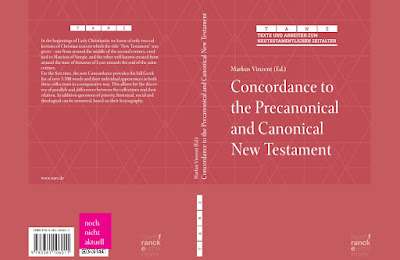
The first product of this endeavour is the publication of a comparative "Concordance to the precanonical and canonical New Testament" that is going to be published with NarrFranckeAttempto on

19 June 2023


Concordance


I hope to finish the reconstruction and the introduction to it sometime later this summer, so watch out for it.

Thursday, 9 March 2023

A first concordance of the canonical New Testament in comparison with the precanonical New Testament

 In due course, the Tübingen publishing house Narr Francke Attempto will publish my comparative concordance where you will be able to find the list of almost all NT terms (over 5.500) and can check, if and where these appear in the precanonical collection of Marcion's New Testament.

The concordance allows for a better understanding of both collections and how best to determine their inter-relations.


Tuesday, 29 November 2022

Is Luke's Geography all skrewed up? On John Kloppenburg in Jacob Berman's History Channel

 A short time ago, John Kloppenburg featured on Jacob Berman's History Channel with the following interview: https://www.youtube.com/watch?v=AHX7OeVwbzw


As I am going through the entire vocabulary of the New Testament at the moment, to compare the lexicography of the Marcionite collection to that of the canonical New Testament, the following appears with regards to the mention of city or cities in both collections.

From the list below, it appears that what John Kloppenburg is saying with regards to 'Luke' captures, indeed, the one who is responsible for Acts and also for the redaction of Marcion's Gospel. Marcion himself seems to have been more knowledgeable about the geography than his redactor. Just like 'Matthew' does, Marcion speaks of Kapharnaum as a city (Mt 9,1), but almost all other references to cities are unattested for his Gospel, and neither is the passage that Kloppenburg mentions on Chorazin, Bethsaida and Kapharnaum, Tyros and Sidon when Jesus is already on his way, far away from there.
It seems, therefore, that - wherever Acts was written, this redaction shares the 'citification' of the landscape, not yet known to Marcion's Gospel, and, if we add, his Pauline letter collection. Here, again, it is only in Rom 16:23 (note, that the last two chapters of Rom are missing in Marcion's Rom) that there is explicit mention of 'city', and in 2Cor 12:26, a chapter missing in Marcion's 2Cor, Paul speaks of the perils of the city, after having mentioned in 2Cor 11:32 (another chapter missing in Marcion's 2Cor) the city of Damascus. Except for these mentions, Paul never makes city his concern.


* indicates that the word is present in Marcion's collection

*πόλις

174

*Ev 4,31. 43; 9,6 (? Adamantius, accepted by Klinghardt and NA28); 14,21

in Lc 8,1. 39; 13,22; 19,41; 23,50; 24,48, verses that are absent from *Ev , then Lc 7,37, where this part is missing in *Ev fehlt, but present in Mt 2,23; 4,5; 5,14. 35; 8,33. 34; 9,1. 35; 10,5. 11. 14. 15. 23; 11,1. 20; 12,25; 14,13; 21,10. 17. 18; 22,7; 23,34; 26,18; 27,53; 28,11; Mc 1,33. 45; 5,14; 6,11. 33. 56; 11,19; 14,13. 16; Lc 1,26. 39; 2,3. 4. 11. 39; 4,29. 31. 43; 5,12; 7,11. 12. 37; 8,1. 4. 27. 34. 39; 9,5. 10; 10,1. 8. 10. 11. 12; 13,22; 14,21; 18,2. 3; 19,17. 19. 41; 22,10; 23,19. 51; 24,49; Jn 1,44; 4,5. 8. 28. 30. 39; 11,54; 19,20; Acts 4,27; 5,16; 7,58; 8,5. 8. 9. 40; 9,6; 10,9; 11,5; 12,10; 13,44. 50; 14,4. 6. 13. 19. 20. 21; 15,21. 36; 16,4. 11. 12. 13. 14. 20. 39; 17,5. 16; 18,10; 19,29. 35; 20,23; 21,5. 29. 30. 39; 22,3; 24,12; 25,23; 26,11; 27,8; Rom 16,23; 2Cor 11,26. 32; Ti 1,5; Heb 11,10. 16; 12,22; 13,14; Jas 4,13; 2Pet 2,6; Jude 1,7; Rev 3,12; 11,2. 8. 13; 14,20; 16,19; 17,18; 18,10. 16. 18. 19. 21; 20,9; 21,2. 10. 14. 15. 16. 18. 19. 21. 23; 22,14. 19

Thursday, 30 September 2021

Christi Thora. Die Entstehung des Neuen Testaments im 2. Jahrhundert, the new monograph to appear with Herder in 2022

 Today I received the Cover design for the new Herder monograph that is going to appear in February 2022 and which deals with the emergence of the New Testament as a collection during the 2nd century. Though colleagues generally agree that the NT as a collection dates to this 2nd century, so far there is no agreement how this collection came together, was it an organic process, was it a deliberate redaction by one of a small group of people, did it happen in any other way. This problem is going to be addressed by the new monograph, and I am looking forward to your responses.

The book will also appear in an English version, on which I am working right now.

Here the cover design:


Friday, 23 April 2021

The first hundred years of Christianity - an answer to Udo Schnelle

 In his 2019 American version, translated by James W. Thompson from the 3rd. rev. edition of the German 'Die ersten 100 Jahre des Christentums', Udo Schnelle discusses 'the formation of the Canon' and claims: 'The formation of the canon was a further step toward the developing independent identity of early Christianity. This process was essentially borne by the churches, defining the specific writings that possessed authority. It was not authoritative statements of individuals, movements, or synods that gave rise to the collectino of Holy Scriptures but rather a process with an inner conistency and necessity: the OT as the established canon, the authoritative claim of the Pauline letters and the Gospels, as well as the growing distance from the original events necessitated a reception of the relevant witnesses for the Christian faith. The formation of canon belongs within this process of the necessary and consistent self-definition of teh church. The intention of the predominant arrangement is obvious: After the fourfold portrayal of teh story of Jesus Christ, the book of Acts forms the transition and orientation for reading the Pauline letters, which were then supplemented by the writings of the other apostles; the reading matter then finally flows into the eschatological perspective of the Revelation of John. Primarily with the letters of Paul and the Gospels, Jesus of Nazareth and Paul stand at the beginning of the tradition; they aree to a certain extent accessible as a "book" and produce an unexpected effect' (ibid. 466-467).

The counterposition that I hold is summarized and rejected in a kind footnote (p. 466-467, n. 41) which reads: 'The common claim that before Marcion (in Rome ca. 140; in his home in Sinope ca. 120 CE) no evidence exists for a Gospel (e.g. Vinzent, Die Auferstehung Christi, 119-20) is not convincing. The Didache (ca. 120) presupposes the presence of the Gospel of Matthew and (indirectly) the Gospel of Mark (cf. Did. 15.3//Matt. 18:15; Did. 8.2//Matt.6:7-13; Did. 9.5//Matt. 7:6a; Did. 7.1//Matt. 28:19; Did. 8.1-2//Matt. 6:2, 5; Did. 11.7//Matt. 12:31-32; Did. 16.1//Matt. 24:42; 25:1-13'. For the detailed argument, cf. Wengst, Didache, 24-32. The Papias fragment (ca. 130) in Eusebius (Hist. eccl. 3.34.15-16) attests Mark and Matthew as writers of Gospels. Justin, the contemporary of Marcion, cites from the written text of Matthew (Matt. 11;17) and presupposes readings from the Gospels each Sunday (1 Apol. 67.3). Moreover, the Lord's Supper tradition in 1 Apol. 66.3 refers explicitly to the tradition of the Gospels (cf. Luke 22:19). The Gospel of John is attested in P52 (middle of the second half of the second century CE) in Egypt and must have been written a considerable time before that. For the Gospel of Luke, Marcion is the first (indirect) witness. However this fact certainly does not preclude its being written considerably earlier. The classic dating of the Gospels (and Acts) between 70 and 100 CE is evident in the situation presupposed in them and the history of early Christianity. Without the Jesus traditions of the Gospels, the expansion of Christianity in this period is not conceivable'.

I do not want to discuss the formation of the canon, as I have just written a chapter on this topic for the forthcoming volume The New Testament Canon in Contemporary Research, edited by Stanley E. Porter and Benjamin Laird, Brill.

Instead, let me concentrate on the arguments that make my position seem 'unconvincing' to Schnelle. Of course, these arguments are not new, but they are nicely condensed in the quoted footnote:

He rejects, that 'no evidence exists for a Gospel' prior to Marcion. As counter-arguments he takes:

1. The Didache and 'the presence of the Gospel of Matthew and (indirectly) the Gospel of Mark'.

2. The Papias fragment that 'attests Mark and Matthew as writers of Gospels'.

3. Justin who 'cites from the written text of Matthew'.

4. P52 as mid-secondary witness to the Gospel of John.

5. Marcion as (indirect) witness for the Gospel of Luke.

6. No expansion of Christianity without 'the Jesus traditions of the Gospels'.


Before I take them one by one, it is obvious that the argument against me pointing out the uncertainty of the dating of the Gospels (and Acts) and the likelihood that they are mid second century products rather than first century products is countered by the early dating of sources which are as uncertain as the creation of the Gospels and Acts (nn. 1.2.4): The Didache, Papias, P52 are uncertain with regards dating, and the early dating of the Didache is usually argued for with the presence of Matthew and the absence of other Gospeltraditions, Papias has been similarly dated, but uncertainty remains. And the dating of P52 by Colin H. Roberts in 1935, to ‘the first half of the second century’ and the further use of this dating by NT scholars has been called by papyrologist B. Nogbri already in 2005 an 'abuse' of this evidence. The conclusion is: Schnelle (together with many others, as he only represents the opinio communis) provides a circular argument and suggests secure datings, based on insecure datings which themselves have been secured by what they are supposed to secure. Who finds this convincing, might stop reading any further.

A further more general note: my argument is shortened to distortion. When I say that no Gospel existed prior to Marcion, I take as Gospel the combination of 'words and deeds' of the Lord, as I say in many places that prior and contemporary to Marcion oral traditions of sayings of the Lord are, indeed, attested. We only need to take the - although few - sayings of the Lord that we find in Paul's letters, then there are other sayings which we find in Ignatius and elsewhere. Two observations, however, need explanation: First, why most of these sayings are Agrapha and do not appear in any of our canonical Gospels, second, why the only elements that are attested are sayings, no deeds of the Lord, hence, no miracle, no narratives asf., a phenomenon that already Kurt Aland had pointed out. This leads us already to the discussion of the items from above:

In more detail:

1. The Didache and 'the presence of the Gospel of Matthew and (indirectly) the Gospel of Mark'.
Before we make a judgement on details, a preliminary fact: The text of the Didache, as Wengst who has been referrred to by Schnelle, points out, was, as the manuscript evidence shows, secondarily gospelized. Wengst, therefore, deviates from other editions, and leaves aside the heaviest gospelized section. Nevertheless, even the text that he gives is based on manuscript evidence that is later than the fourth century. And we just become highly suspicious of any text like the Didache which is preserved in the same manuscript, the Hierosolymitanus, which also contains the 14 letters collection of Ignatius - providing us with a second century collection which - as scholars acknowledge - was not only broadened by additional 6 letters, but also gives us a text that has been through and through gospelized and biblicized. What gives us the assurance that many, if not all of the parallels that Schnelle provides, have been introduced later? Yet, even if we assume, these were original, we have to note that all are sayings, and not a single one refers to deeds of Jesus. To draw from such parallels that the Didache is based on the Gospel of Matthew and indirectly on Mark is only maintained by scholars who also subscribe to the Didache being a terminus ante quem for these two Gospels. Again, we are in a dead ally of a circular argument. Elsewhere I have made a more detailed comparison.

2. That Papias 'attests Mark and Matthew as writers of Gospels' is simply and factually incorrect. Papias, in the fragments that survived and are given by Eusebius, never mentions the term 'Gospel'. The two are mentioned as translator and writer (Mark) and as redactor (Matthew), but what their products were, we do not know. Only because we later have Gospels that are connected with these two names, Eusebius in his framing text calls Mark a 'gospelwriter', Papias does not. Schnelle had better mentioned Papias' other fragment which has come to us not through Eusebius, but through the antimarcionite Western Bible prologues. In there, however, we are told about John's and Marcion's critical engagement which puts both John as well as Papias much later.

3. Justin is of cause not a good witness for Schnelle's argument, as he lives contemporary to Marcion and is seriously engaged with him (as, according to Papias John was). The position that Justin 'cites from the written text of Matthew' is not shared by many Justin scholars.

4. P52 and the NT-misuse of its papyrological dating has been mentioned before.

5. On Marcion as an indirect witness to the Gospel of Luke could be strengthened. As I have shown in various places, Marcion - according to Tertullian - attests to all four Gospels, yet he claims that these are plagiarisms of his own Gospel. Whether Marcion or Tertullian states the truth is the question to decide upon. To uncritically follow Tertullian does not seem a sound apriori position.

6. Expansion of Christianity ... If we acknowledge that even the term 'Christianity' is absent in the first century and appears for the first time with Marcion, it is problematic to retroject this identity claim into the first century. The assumption of rapid expansion only works - again in my view a circular argument - when one dates, as done in Schnelle, all the canonical texts into the first 100 years, and turns those 100 years from a history of the development of Jewish traditions, into one of 'Christianity' vs. 'Judaism'. In this, however, one unconsciously follows Marcion's trajectory. Marcion, however, was more careful than those readers, as he did not disinherit Jews and their traditions, but created a novel form of a Jewish cult which he called 'Christianity'. Only readers of him like Justin and, unfortunately, the plagiarists of Marcion's Gospel, turned his antitheses into an anti-Judaism which left nothing of the genuine tradition to the Jews, but turned it into a Christian Bible in which the core Gospels 'define (negatively) their relationship to Judaism' (p. 426).

Now ten years ago, I tentatively saw good reasons to advocate a turning over of NT studies and an entire revision of the most basic assumptions. Criticism like Schnelle's footnote from 2019 makes me even more aware, how fragile these counter-claims are and that assumptions based on such foundations will not last for very long. 

Tuesday, 16 October 2018

καινὴ διαθήκη: Der Titel des "Neuen Testaments" bei Irenäus von Lyon

My usual readers may excuse me writing in German, but I am writing at present a history of the beginnings of Christianity for a German publisher, hence, the text that follows as an extract from this book is in German. I hope that, once the book is published, there will follow an English translation.
            
Der Titel der Sammlung „Neues Testament“, der griechisch καινὴ διαθήκη und lateinisch novum testamentum lautet stellt ein spezifisches Problem dar, das verknüpft ist mit diesem Sprachgebrauch, weil sowohl im Griechischen wie im Lateinischen diese Begriffe nicht nur als Übersetzung des Titels dieser Sammlung von Schriften steht, sondern auch geprägt ist durch die Septuagintaübersetzung der hebräischen Bibel, in welcher διαθήκη für den „Bund“ (brit) steht, den Gott mit den Menschen geschlossen hat. Mehr noch, das Griechische wie das Lateinische „Testament“ kann für die erbschaftsrechtliche Verfügung im ganz allgemeinen Sinne benutzt werden,[1] wie es etwa auch in Gal. 3,15.17 und Heb. 9,16f. der Fall ist. Theodor Zahn verwies bereits darauf, dass „διαθήκη in der Bibel den von Gott gestifteten Bund (bezeichnete), die von Gott der Gemeinde gegebene Ordnung ihres Verhältnisses zu ihm, und καινὴ διαθήκη eine der Endzeit vorbehaltene, durch Christus gestiftete Neuordnung dieses Verhältnisses, als nicht Offenbarungsurkunde, sondern Offenbarung“ meinte.[2] Bevor man also in den Schriften, auch des Irenäus, den terminus technicus für den Titel vorzufinden glaubt, muss man erst prüfen, ob nicht einer der älteren Inhalte nicht im Sinne von schriftlichen Urkunden, sondern von Ordnung und Bund gemeint ist, und wenn ein Schriftstück bezeichnet zu werden scheint, ob es auf eine Erbschaftsanordnung geht, oder wirklich die Sammlung von Schriften bedeutet wird.[3]
Für Irenäus gibt es die beiden „Testamente“.[4] Bei der Diskussion des Liebesgebotes verweist Irenäus darauf, „dass die wesentlichen Gebote für das Leben in beiden Testamenten dieselben sind und auf denselben Herrn verweisen, der zwar die Einzelgebote den Umständen beider Testamente angepasst hat, als die wichtigeren und höchsten Gebote aber, ohne die man nicht erlöst werden kann, in beiden Testamenten dieselben gegeben hat“.[5] Und an späterer Stelle betont er, „dass es zwei Synagogen in zwei Völkern gab und dass es trotzdem ein und derselbe Gott ist, der sie beide zum Nutzen der Menschen eingerichtet hat; dementsprechend wurden die Testamente denen gegeben, die zum Glauben an Gott kamen ... Außerdem auch, dass das erste Testament weder unnütz noch vergeblich oder zufällig gegeben worden ist“.[6]
Auffallenderweise setzt Irenäus die beiden Testamente an der ersten Stelle gleich mit „Gesetz“ (lex) und „Evangelium“ (evangelium) und an der zweiten mit „erstem Testament (prius testamentum) und „Evangelium“. In einem anderen Kapitel wird deutlich, dass Irenäus auch die Schriften des Paulus zum Neuen Testament hinzuzählt.[7] An einer weiteren Stelle liegt eindeutig der Begriff διαθήκη (testamentum) als Erbschaftstestament vor, interessanterweise noch kombiniert mit „Evangelium“: Die Glieder der Menschen „werden vom Geist zum Erbe genommen und ins Himmelreich gebracht. Deshalb aber ist Christus auch gestorben: Das Testament des Evangeliums, das eröffnet und in der gesamten Welt gelesen werden sollte, sollte zuerst seine Knechte frei machen. Darauf sollte es sie dann zu Erben seiner Güter einsetzen ... Wer lebt ergreift nämlich Besitz vom Erbe.“[8] Hier wird deutlich, dass für Irenäus „Testament“ nicht nur wie meist in seinen Schriften als „Bund“ zu verstehen ist, sondern gerade mit Blick auf das Evangelium als Erbüberlassung.
Insgesamt wird deutlich, Irenäus nutzt die Vorstellung vom „Testament“ als „Bund“, einmal auch als „Erbschaftsurkunde/-überlassung“, doch nur an zwei gesicherten Stellen benutzt er den Begriff zur Kennzeichnung der Sammlungen von Schriften. An beiden Stellen spricht er nicht von einem Testament, sondern von zweien, wobei er das eine, auch das „erste“ genannte, mit dem Gesetz gleichsetzt, das andere mit dem Evangelium (zu diesem Testament zählt er auch die Paulusbriefe an anderer Stelle). Noch auffallender aber ist, dass die Gegensetzung der beiden Testamente wie auch die Gleichsetzung mit einerseits Gesetz, andererseits Evangelium auf den älteren Sprachgebrauch hindeuten, in welchen Markion sowohl den Begriff „Neues Testament“ im Gegensatz zu „Altem Testament“ geprägt hat, und Irenäus an beiden Stellen in Adversus haereses sich tatsächlich mit Markion und seinen Anhängern auseinandersetzt. Im Anschluss an die erste Stelle resümiert Irenäus: „Es gibt ja noch mehr solcher Gebote. Sie bedeuten aber alle keinen Widerspruch (contrarietas) und keine Auflösung der alten Gebote, wie das die Anhänger Markions daherschreien“.[9] Und auf die zweite Stelle, die mit dem antimarkionitischen anonymen Presbyterbericht verbunden ist,[10] folgt: „Er wird aber auch die Lehre Markions richten“.[11]
Aus alledem kann man bezüglich Irenäus nur dieselbe Schlussfolgerung ziehen, die Wolfram Kinzig bereits bei seiner Untersuchung zum Sprachgebrauch von testamentum bei Tertullian vertreten hat: Ausschließlich wenn die Rede von Markion und seiner Position die Rede ist, verfällt der Berichterstatter in den Sprachgebrauch dessen, über den er berichtet, und spricht von „Testament“ im technischen Sinne als von einer Sammlung von Schriften.[12] Während dieser technische Gebrauch von „Neuem Testament“ bei Tertullian begegnet, findet er sich jedoch noch nicht bei Irenäus, der nur von den beiden Testamenten spricht, auch von einem ersten, doch sowohl von Markions antithetischen Charakterisierungen dieser Testamente als „Altes“ und „Neues“ Testament absieht, wie er überhaupt Markions Einleitung zu seinem „Neuen Testament“, Antitheses genannt, durch seine Bestreitung des antithetischen Charakters (contrarietates) der beiden Testamente, wie gezeigt wurde, ablehnt. Es scheint mir darum ausgeschlossen, dass Irenäus die Sammlung der Schriften, die uns als „Neues Testament“ bekannt ist, bereits unter diesem Namen akzeptiert hatte. Wohl muss er die Titel „Altes“ und „Neues Testament“ von Markion her gekannt haben, doch während er von den Testamenten sprechen konnte, konnte er sich offenkundig noch nicht durchringen die Schriftsammlung der Christen, die er als solche zu kennen scheint, als „Neues Testament“ zu bezeichnen.
Wie wir sehen werden, und worauf ebenfalls Wolfram Kinzig bereits hingewiesen hatte, benutzt auch Justin der Märtyrer, der etwas älter als Irenäus ist, den Begriff des „Neuen Testaments“ nie als Sammlungstitel, obwohl „bei Justin die Gegenübersetzung von alter und neuer διαθήκη eine große Rolle spielt“.[13]
Wenn „allerdings das uniforme Zeugnis der existierenden Überlieferung deutlich darauf hinweist, dass dies („Das Neue Testament“) der Titel des Archetyps“ war, dann müsste man davon ausgehen, dass die Sammlung von neutestamentlichen Schriften, die Irenäus kannte, bewusst eine – wenn auch kritische – Fortführung und Überarbeitung der älteren Sammlung darstellte, die auf Markion zurückgeht und die von Irenäus dem Inhalt nach, nicht aber, was ihren Titel betraf, akzeptiert und titellos propagiert wurde.


[1] Vgl. (Kinzig 1994)
[2] (Zahn 1888/1892: 103)
[3] Sowohl die gängigen deutschen wie englischen Übersetzungen des Irenäus sind hier nicht immer präzise, außerdem gibt es Zweifelsfälle, in denen es schwer zu entscheiden ist, welche der Übersetzung zu verwenden ist. Als Beispiele dienen Iren., Adv. haer. IV 17,5 und 28,1-2 wo es in der englischen Übersetzung (ANL) für „hic et illic“ „both Testaments“ und schließlich für „in novo testamento“ „New Testament“ heißt, während die deutsche Übersetzung hier korrekt von „Bund“ spricht. Ähnlich gelagert ist der Fall in Iren., Adv. haer. V 34,1. Der gleiche Befund begegnet in der Übersetzung von Epid. 91. Ein schwieriger Fall ist Iren., Adv. haer. IV 32, wo innerhalb langer Überlegungen zum Thema altem und neuem Bund dieses Kapitel kommt, in denen doch wohl eher von „beiden Testamenten“ die Rede ist, so auch die englische und deutsche Übersetzung.
[4] Vgl. Iren., Adv. haer. IV 12,3; 28,1; 32,1-2.
[5] Iren., Adv. haer. IV 12,3.
[6] Iren., Adv. haer. IV 32,2.
[7] Vgl. Iren., Adv. haer. IV 15,2.
[8] Iren., Adv. haer. V 9,4.
[9] Iren., Adv. haer. IV 13,1.
[10] Der Bericht findet sich Iren., Adv. haer. IV 27-32; vgl. zu diesem Bericht mit älterer Literatur (Vinzent 2014: 52-55)
[11] Iren., Adv. haer. IV 33,1.
[12] (Kinzig 1994)
[13] (Kinzig 1994: 528) Dort auch ältere Literatur.