Markus Vinzent's Blog

Showing posts with label early Christianity. Show all posts

Saturday, 14 February 2026

Judith Lieu, review on my Christ's Torah in SBL

 It is nice to see this in-depth, critical and welcoming review that my fine colleague Professor Judith Lieu has recently published in SBL. The view ends with the following paragraph:

"So, what are those anticipated nonspecialists to make of all this? Hints during the course of the work become explicit in his concluding suggestion that “many of [the] demarcations” of the modern world, between religions, cultures, institutions, “were historically conditioned, perhaps even once useful and helpful in some respects but must be reexamined again and again in terms of their necessity and usefulness” (354). This may surprise few, even if its application to the New Testament is less welcome. Nonetheless, as Markus Vinzent doggedly builds up his body of work into the uncertainties of any rediscovery of the earliest Christian period and writings, scholars in the field cannot avoid taking seriously his analysis, conclusions, and extensive command of patristic literature. The time is long past when his own (and others’) radical rereadings could be dismissed as maverick while “mainstream” scholarship carries on undisturbed."

Tuesday, 30 April 2024

Interview on 'Resetting Christian Origins' (CUP)

For all those interested in this recent book of mine, I have given an interview to Jonathon Lookadoo. My host is Associate Professor at the Presbyterian University and Theological Seminary in Seoul, South Korea. While his interests range widely over the world of early Christianity, he is the author of books on the Epistle of Barnabas, Ignatius of Antioch, and the Shepherd of Hermas, including The Christology of Ignatius of Antioch (Cascade, 2023).

Being a scholar of early Christian studies himself, it was great to talk to him and answer his questions at New Books Network / New Books in Biblical Studies, under the following link: Markus Vinzent, "Resetting the Origins of Christianity: A New Theory of Sources and Beginnings" (Cambridge UP, 2022) - New Books Network


Sunday, 25 February 2024

The Beginnings of Early Christianity: How does the 2nd century relate to the 1st century

 I received the following friendly enquiry:

"With regard to the books: "Resetting the Origins of Christianity", "Christ's Torah" and "Christ's Resurrection in Early Christianity" - I admire the approach of these books to reconstruct historically grown ideas and validity claims retrospectively. I understand that you place weight to the 2nd century for the emergence of the New Testament. So far, however, it has not been entirely clear to me how you establish the relationship between the 2nd century and the 1st century. Sometimes it seems to me that you - like most scholars - assume a Christian movement that began in the 1st century leaving behind textual evidence such as at least the Pauline epistles (or parts of them). But then I have the impression that you - like the Dutch radical critics - think of Christianity as a product of the 2nd century in every respect.

I would be very happy to hear how you understand the relationship between the 2nd century and the 1st century in the development of the Christian tradition (not just the scriptures). 


To this I replied:

In answer to your question, I confess that, in my opinion, the first century has so far been the black box into which researchers (and many outside them) have put what they would like to see in it. As I am only too aware of this danger myself in retrospect, I endeavour first of all not to "assume" either the one position you mentioned, the second or any other position. Rather, I approach it through all the centuries and ask myself which is the earliest achievable level on which we can find contours and constructions (and thereby construct ourselves again). So first of all I confess my ignorance beyond this. As you have rightly recognised, the next main question, which I have already asked myself in the books you mention but only answered very cautiously, is how one could describe the relationship between the 2nd and 1st centuries.

I have gained a little more insight into this in the last three years, because during this time I have reconstructed the Pauline letters as suggested by the witnesses to Markion's collection. Although Hilgenfeld - Zahn - Harnack - Schmid and BeDuhn had already undertaken such reconstructions, the first four of these editors still proceeded from the heresiological model of Markionite editorial abridgement (although the edition of the canonical Pauline epistles first appears before our eyes with Irenaeus, i.e. a good three decades after that of Markion) and therefore offer only deviations, but no continuous text, while BeDuhn offers a largely continuous text of the letters, but only in English translation.

In my reconstruction, I noticed that the two collections (1. the 10-letter collection of Markion; 2. the 14-letter collection from the time of Irenaeus) have strikingly different languages and semantics. Furthermore, it is striking that the three letters Eph, Col and 2Thess, which today are regarded as pseudo-Paulines, differ from the 7 letters found in the 10-letter collection even in the "pre-canonical" version (i.e. as parts of the 10-letter collection) in that they possess a language in many respects that we encounter in the 14-letter collection.

This trace opens a small door into the time before Marcion, perhaps even into the 1st century - hence my comments for you.

The fact that Marcion's collection of 10 letters contains a lexis, semantics, a grammar etc. that is clearly identifiable and different from those of the 14-letter collection shows: 

1. that there was a redaction of this 10-letter collection (one can of course ask whether by Marcion or by an earlier editor, if Marcion had indeed, as Lieu, BeDuhn, Klinghardt, Goldmann, Flemming assume, changed nothing or nothing significant about these letters)

2. that there was a further, later redaction of this collection of 10 letters, when it was expanded into a collection of 14 letters at the time of Irenaeus.

3. here the view into the time before Marcion: that 3 letters were included in the 10-letter collection, which are already characterised by a language that we encounter again in the canonical editing of the 14-letter collection.

4 This means, however, that in his search for Pauline letters or letter material, the editor had not only come across 7 letters (whether already in a collection remains to be investigated), which after the redaction appear uniform in language throughout, while he must have come across a collection of 3 letters that came from a linguistic-religious-cultural milieu that was that of the later canonical redaction. Even after the pre-canonical redaction, the parallels to the later canonical redaction can still be recognised.

5) After the pre-canonical editing of all 10 letters, the 10-letter collection came into the milieu from which the 3 letters originated. In this milieu, the 10-letter collection was expanded into the 14-letter collection and canonically edited into the form that we find today in the canonical New Testament.

A further insight became clear to me when I compiled the "Concordance to the Precanonical and Canonical New Testament (narr.de)":

6. the 10-letter collection has largely the same linguistic features as the pre-canonical Gospel of Marcion's New Testament.

7. the other parts of the canonical collection of the 27 books beyond the 14-letter collection largely share a common canonical language (despite all the individual differences of all their individual writings).

This means that if we want to look back from the 2nd to the 1st century, the following questions will have to be answered: Who is the redactor who presents a single Gospel text and 10 Pauline letters that are demonstrably from one and the same hand?

What is the character of the 3 letters used by this editor? Are they literary fiction or do they go back to older material, possibly to a "Paul"? Since they must have already existed in a collection due to their linguistic similarities, do they represent the older level in comparison to the 7 letters offered by the editor? If this were the case, then the letters now regarded as pseudo-Paulines would be older and closer to Paul than the so-called "genuine" 7 letters. 

Or is it precisely the fact that the 3 letters were already edited as a collection that speaks against their more original character? Since the editor - knowing what an editor is and does - must have known that it was an edited collection of the 3 letters, which he included in his own collection of 10 letters, he obviously saw no problem in using edited texts, editing them himself and still putting them under the label "Paul". 

As far as the source(s) of the 7 letters are concerned, the question of whether the editor used individual letters or a collection cannot be answered just as clearly. The fact that the editor left the three letters together, placed five letters before them and two after, and that he arranged his collection of 10 letters biographically and geographically, just as he arranged the Jesus material biographically and geographically, rather suggests that he had not yet found the seven letters as a collection. For if the 7 letters had been available to him as a collection and if he had also drawn on an older Gospel, then it would be more than coincidental if both older sources (Gospel, 7 letters) had the same organisational structure. What is historically probable is that he possessed epistolary material for the 7 letters, just as he possessed Jesus material, from which he created partial collections for his New Testament, which he structured similarly and which also both reflect his editorial language.


What does this mean for our insight into the 1st century? Especially for your question about the Christian movement and, I would add, its protagonists? In "Christ's Torah" I have already pointed out that the editor also includes elements (such as "bringing fire/conflict") that contradict his own idea. This suggests that there is a previous source for this material, which the editor traces back to the Jesus of his gospel. Similar elements that seem to contradict his idea can also be found in the letters of Paul in the 10-letter collection. Here, too, the editor cites Paul as the source. Can we trust this information? It seems to me, as I have already written, that the editor was not someone who produced pseudonymous fictions - a significant difference to the canonical editors, for whom pseudonymity and fictionality are  characteristic features. That is why we still do not have any letters that scholars attribute to Paul other than the seven that can be found in the 10-letter collection. I would therefore rate the confidence in this editor higher rather than lower.


Who could this editor be if the Gospel and the 10-letter collection were written by his consistently editorial hand?

1) An ultra-conservative answer could be: Paul. Then Paul not only brought a message, but this gospel to the Galatians.

Or, if this is not considered possible,

2. a disciple of Paul, perhaps Luke. Then he would be the author/editor of the gospel and the 10 Pauline letters.

3. an anonymous person (as assumed by BeDuhn, Lieu, Klinghardt ...), who then wrote both parts.

Or, what I consider to be the most likely solution, especially in view of the witnesses of the 2nd century:

4th Markion.

Friday, 26 May 2023

when I am getting a bit quiet ...

 then I am working on something substantial. Hence, sorry about being slow in moderating the blog and posting here. However, I have worked my socks off to produce a reconstruction of pre-canonical Paul, the ten letters of the collection that Marcion of Sinope brought together sometime after the end of the so-called Bar Kokhba revolt, i.e. after the year 135 CE.

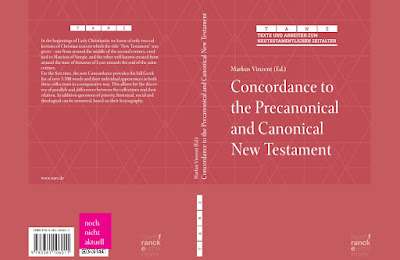
The first product of this endeavour is the publication of a comparative "Concordance to the precanonical and canonical New Testament" that is going to be published with NarrFranckeAttempto on

19 June 2023


Concordance


I hope to finish the reconstruction and the introduction to it sometime later this summer, so watch out for it.

Race, Ethnicity and Family in Late Antique Judaism and Early Christianity

This is a new article, just published as open access article in 


Religions | Free Full-Text | Race, Ethnicity and Family in Late Antique Judaism and Early Christianity (mdpi.com)


Tuesday, 29 November 2022

Is Luke's Geography all skrewed up? On John Kloppenburg in Jacob Berman's History Channel

 A short time ago, John Kloppenburg featured on Jacob Berman's History Channel with the following interview: https://www.youtube.com/watch?v=AHX7OeVwbzw


As I am going through the entire vocabulary of the New Testament at the moment, to compare the lexicography of the Marcionite collection to that of the canonical New Testament, the following appears with regards to the mention of city or cities in both collections.

From the list below, it appears that what John Kloppenburg is saying with regards to 'Luke' captures, indeed, the one who is responsible for Acts and also for the redaction of Marcion's Gospel. Marcion himself seems to have been more knowledgeable about the geography than his redactor. Just like 'Matthew' does, Marcion speaks of Kapharnaum as a city (Mt 9,1), but almost all other references to cities are unattested for his Gospel, and neither is the passage that Kloppenburg mentions on Chorazin, Bethsaida and Kapharnaum, Tyros and Sidon when Jesus is already on his way, far away from there.
It seems, therefore, that - wherever Acts was written, this redaction shares the 'citification' of the landscape, not yet known to Marcion's Gospel, and, if we add, his Pauline letter collection. Here, again, it is only in Rom 16:23 (note, that the last two chapters of Rom are missing in Marcion's Rom) that there is explicit mention of 'city', and in 2Cor 12:26, a chapter missing in Marcion's 2Cor, Paul speaks of the perils of the city, after having mentioned in 2Cor 11:32 (another chapter missing in Marcion's 2Cor) the city of Damascus. Except for these mentions, Paul never makes city his concern.


* indicates that the word is present in Marcion's collection

*πόλις

174

*Ev 4,31. 43; 9,6 (? Adamantius, accepted by Klinghardt and NA28); 14,21

in Lc 8,1. 39; 13,22; 19,41; 23,50; 24,48, verses that are absent from *Ev , then Lc 7,37, where this part is missing in *Ev fehlt, but present in Mt 2,23; 4,5; 5,14. 35; 8,33. 34; 9,1. 35; 10,5. 11. 14. 15. 23; 11,1. 20; 12,25; 14,13; 21,10. 17. 18; 22,7; 23,34; 26,18; 27,53; 28,11; Mc 1,33. 45; 5,14; 6,11. 33. 56; 11,19; 14,13. 16; Lc 1,26. 39; 2,3. 4. 11. 39; 4,29. 31. 43; 5,12; 7,11. 12. 37; 8,1. 4. 27. 34. 39; 9,5. 10; 10,1. 8. 10. 11. 12; 13,22; 14,21; 18,2. 3; 19,17. 19. 41; 22,10; 23,19. 51; 24,49; Jn 1,44; 4,5. 8. 28. 30. 39; 11,54; 19,20; Acts 4,27; 5,16; 7,58; 8,5. 8. 9. 40; 9,6; 10,9; 11,5; 12,10; 13,44. 50; 14,4. 6. 13. 19. 20. 21; 15,21. 36; 16,4. 11. 12. 13. 14. 20. 39; 17,5. 16; 18,10; 19,29. 35; 20,23; 21,5. 29. 30. 39; 22,3; 24,12; 25,23; 26,11; 27,8; Rom 16,23; 2Cor 11,26. 32; Ti 1,5; Heb 11,10. 16; 12,22; 13,14; Jas 4,13; 2Pet 2,6; Jude 1,7; Rev 3,12; 11,2. 8. 13; 14,20; 16,19; 17,18; 18,10. 16. 18. 19. 21; 20,9; 21,2. 10. 14. 15. 16. 18. 19. 21. 23; 22,14. 19

Monday, 8 November 2021

What was the title of Marcion's collection of Paul's letters: Apostolos or Apostolikon? Wie lautete der Titel von Markions Paulusbriefsammlung, Apostolos oder Apostolikon?

The title of Marcion's collection of Paul's letters is mostly given as "Apostolikon" (so, for example, in Jason BeDuhn, The First New Testament, Polebridge 2013), but, as in one of the major studies of this work, in Ulrich Schmid ("Marion und sein Apostolos. Rekonstruktion und historische Einordnung der marcionitischen Paulusbriefausgabe, de Gruyter 2012), it is named as "Apostolos".

Tertullian is silent about the title of this collection, but the title appears several times in Epiphanius, where it mainly given as Apostolikon, and only in passing also referred to as Apostolos. When we find the title for the first time in Epiphanius, he speaks of Marcion's Apostolikon – yet, as with the list of the letters which Marcion brought together and altered by "his cracked brain", Epiphanius mentions Ephesians, not the title under which Marcion knew and listete this letter, Laodicenes. Hence, it is clear that Epiphanius deploys polemics in characterizing the work of Marcion. And this comes to the fore also with regards the title of the work. While for Marcion Paul was the only true Apostle, Tertullian opened his commentary of Marcion's collection of Pauline letters by showing that Paul could at best be apostolic, not an Apostle, because his name cannot be found in one of the lists of Apostles in any of the Gospels, Tert., Adv. Marc. V 1. It is for the this reason, we can assume that Epiphanius also introduces the title of Marcion's collection not as "Apostolos", but rather calls it "Apostolikon" in anti-heretical polemic, Epiph., Pan. 42,10,2. A little later, he speaks of the „Apostolos“ , ibid. 42,10,3, but only in combination with "the words of the savious and those of the Apostle". Immediately after this, he speaks again of the "Apostolikon" and his own use of language shines through, ibid. 42,10,4. Most clearly, he gives the correct title "Apostolos", when in Epiph., Pan. 42,10,5-7 we read: „... other [verses] were exactly like both the Gospel and Apostle, unchanged by Marcion but capable of completely contradicting him ... to manifest the One who is plainly confessed by the apostolic writing and the proclamation of the Gospel“. The change from "Apostle" to "Apostolic" highlights again the falling into Epiphanius' own polemical style, so also in ibid. 42,11,7 (vgl. auch 42,11,9), where he accuses Marcion of, „having the letters of Paul, the Apostle“, yet not all, but just a few in his „Apostolikon“. 
One further important witness is Jerome who in his Commentary on Galatians (well informed by a whole range of earlier commentators, including various works by Origen), quotes from "Marcion's Apostolos", so Hieron., Commentaria in Epistolam ad Galatas (PL 26, 313A).
I therefore think, Ulrich Schmid has chosen the correct title of this work by calling it „Apostolos“.[1]

Der Titel von Markions Paulusbriefsammlung wird meistens mit "Apostolikon" angegeben (so etwa von Jasen BeDuhn, The First New Testament, Polebridge 2013), doch in einer der zentralen Studien dieses Werkes, in Ulrich Schmid ("Marion und sein Apostolos. Rekonstruktion und historische Einordnung der marcionitischen Paulusbriefausgabe, de Gruyter 2012), heißt das Werk "Apostolos".


Tertullian schweigt sich über den Titel dieses Werkes aus, doch bei Epiphanius begegnet er gleich mehrmals, und zwar häufiger als Apostolikon, und nur angedeutet als Apostolos. Bei der Ersteinführung spricht Epiphanius vom Apostolikon – doch scheint hier wie auch in der ersten unten gespiegelten Liste, die Markions Laodizenerbrief als Epheserbrief einführt, Polemik im Spiel zu sein. Denn während Paulus für Markion der einzige wahre Apostel ist, hatte Tertullian in seiner Polemik in Tert., Adv. Marc. V 1 darauf verwiesen, dass Paulus bestenfalls „apostolisch“ genannt werden könne, weil er in keiner einzigen der Apostellisten der Evangelien vorkomme, also auch nicht eigentlich Apostel sei. Darum führt Epiphanius wohl den Titel als „Apostolikon“ = „das Apostolische“ an, nicht als „der Apostel“, Epiph., Pan. 42,10,2, während er erst etwas später dann einmal vom „Apostolos“ = „dem Apostel“ spricht, ibid. 42,10,3, jedoch nur in Kombination mit: „von den Worten des Retters und des Apostels“. Auch unmittelbar danach spricht er gleich wieder von dem „Apostolischen“, womit seine eigene Diktion zum Vorschein kommt, ibid. 42,10,4. Am deutlichsten wird der richtige Titel danach formuliert, da es bei Epiph., Pan. 42,10,5-7 heißt: „... andere [Verse] aber besitzt er dem Bestand nach wie das Evangelium so auch den Apostel, ohne von ihm verändert zu sein, doch geeignet, ihn zu widerlegen ... um denjenigen zu offenbaren, der offen bekannt wird von der apostolischen Schrift und der evangelischen Verkündigung“. Der Wechsel vom „Apostel“ zum „Apostolischen“ lässt erneut Epiphanius’ eigene polemische Diktion durchklingen, so auch ibid. 42,11,7 (vgl. auch 42,11,9), wo er Markion vorwirft, „die Briefe des Paulus, des Apostels“, jedoch nicht alle, sondern nur einige im „Apostolikon“ zusammengebracht zu haben.
Ein weiterer wichtiger Zeuge ist Hieronymus, der in seinem Galaterbriefkommentar (wohl belesen, indem er Kommentare und Schriften früherer Gelehrter zu Rate zog, etwa verschiedene Schriften des Origenes), und aus "Markions Apostolos" zitiert, so in Hieron., Commentaria in Epistolam ad Galatas (PL 26, 313A).
Ulrich Schmid schreibt deshalb zurecht von Markions „Apostolos“.[1]


[1] U. Schmid, Marcion und sein Apostolos. Rekonstruktion und historische Einordnung der marcionitischen Paulusbriefausgabe (2012).


Thursday, 30 September 2021

Christi Thora. Die Entstehung des Neuen Testaments im 2. Jahrhundert, the new monograph to appear with Herder in 2022

 Today I received the Cover design for the new Herder monograph that is going to appear in February 2022 and which deals with the emergence of the New Testament as a collection during the 2nd century. Though colleagues generally agree that the NT as a collection dates to this 2nd century, so far there is no agreement how this collection came together, was it an organic process, was it a deliberate redaction by one of a small group of people, did it happen in any other way. This problem is going to be addressed by the new monograph, and I am looking forward to your responses.

The book will also appear in an English version, on which I am working right now.

Here the cover design:


Friday, 23 April 2021

The first hundred years of Christianity - an answer to Udo Schnelle

 In his 2019 American version, translated by James W. Thompson from the 3rd. rev. edition of the German 'Die ersten 100 Jahre des Christentums', Udo Schnelle discusses 'the formation of the Canon' and claims: 'The formation of the canon was a further step toward the developing independent identity of early Christianity. This process was essentially borne by the churches, defining the specific writings that possessed authority. It was not authoritative statements of individuals, movements, or synods that gave rise to the collectino of Holy Scriptures but rather a process with an inner conistency and necessity: the OT as the established canon, the authoritative claim of the Pauline letters and the Gospels, as well as the growing distance from the original events necessitated a reception of the relevant witnesses for the Christian faith. The formation of canon belongs within this process of the necessary and consistent self-definition of teh church. The intention of the predominant arrangement is obvious: After the fourfold portrayal of teh story of Jesus Christ, the book of Acts forms the transition and orientation for reading the Pauline letters, which were then supplemented by the writings of the other apostles; the reading matter then finally flows into the eschatological perspective of the Revelation of John. Primarily with the letters of Paul and the Gospels, Jesus of Nazareth and Paul stand at the beginning of the tradition; they aree to a certain extent accessible as a "book" and produce an unexpected effect' (ibid. 466-467).

The counterposition that I hold is summarized and rejected in a kind footnote (p. 466-467, n. 41) which reads: 'The common claim that before Marcion (in Rome ca. 140; in his home in Sinope ca. 120 CE) no evidence exists for a Gospel (e.g. Vinzent, Die Auferstehung Christi, 119-20) is not convincing. The Didache (ca. 120) presupposes the presence of the Gospel of Matthew and (indirectly) the Gospel of Mark (cf. Did. 15.3//Matt. 18:15; Did. 8.2//Matt.6:7-13; Did. 9.5//Matt. 7:6a; Did. 7.1//Matt. 28:19; Did. 8.1-2//Matt. 6:2, 5; Did. 11.7//Matt. 12:31-32; Did. 16.1//Matt. 24:42; 25:1-13'. For the detailed argument, cf. Wengst, Didache, 24-32. The Papias fragment (ca. 130) in Eusebius (Hist. eccl. 3.34.15-16) attests Mark and Matthew as writers of Gospels. Justin, the contemporary of Marcion, cites from the written text of Matthew (Matt. 11;17) and presupposes readings from the Gospels each Sunday (1 Apol. 67.3). Moreover, the Lord's Supper tradition in 1 Apol. 66.3 refers explicitly to the tradition of the Gospels (cf. Luke 22:19). The Gospel of John is attested in P52 (middle of the second half of the second century CE) in Egypt and must have been written a considerable time before that. For the Gospel of Luke, Marcion is the first (indirect) witness. However this fact certainly does not preclude its being written considerably earlier. The classic dating of the Gospels (and Acts) between 70 and 100 CE is evident in the situation presupposed in them and the history of early Christianity. Without the Jesus traditions of the Gospels, the expansion of Christianity in this period is not conceivable'.

I do not want to discuss the formation of the canon, as I have just written a chapter on this topic for the forthcoming volume The New Testament Canon in Contemporary Research, edited by Stanley E. Porter and Benjamin Laird, Brill.

Instead, let me concentrate on the arguments that make my position seem 'unconvincing' to Schnelle. Of course, these arguments are not new, but they are nicely condensed in the quoted footnote:

He rejects, that 'no evidence exists for a Gospel' prior to Marcion. As counter-arguments he takes:

1. The Didache and 'the presence of the Gospel of Matthew and (indirectly) the Gospel of Mark'.

2. The Papias fragment that 'attests Mark and Matthew as writers of Gospels'.

3. Justin who 'cites from the written text of Matthew'.

4. P52 as mid-secondary witness to the Gospel of John.

5. Marcion as (indirect) witness for the Gospel of Luke.

6. No expansion of Christianity without 'the Jesus traditions of the Gospels'.


Before I take them one by one, it is obvious that the argument against me pointing out the uncertainty of the dating of the Gospels (and Acts) and the likelihood that they are mid second century products rather than first century products is countered by the early dating of sources which are as uncertain as the creation of the Gospels and Acts (nn. 1.2.4): The Didache, Papias, P52 are uncertain with regards dating, and the early dating of the Didache is usually argued for with the presence of Matthew and the absence of other Gospeltraditions, Papias has been similarly dated, but uncertainty remains. And the dating of P52 by Colin H. Roberts in 1935, to ‘the first half of the second century’ and the further use of this dating by NT scholars has been called by papyrologist B. Nogbri already in 2005 an 'abuse' of this evidence. The conclusion is: Schnelle (together with many others, as he only represents the opinio communis) provides a circular argument and suggests secure datings, based on insecure datings which themselves have been secured by what they are supposed to secure. Who finds this convincing, might stop reading any further.

A further more general note: my argument is shortened to distortion. When I say that no Gospel existed prior to Marcion, I take as Gospel the combination of 'words and deeds' of the Lord, as I say in many places that prior and contemporary to Marcion oral traditions of sayings of the Lord are, indeed, attested. We only need to take the - although few - sayings of the Lord that we find in Paul's letters, then there are other sayings which we find in Ignatius and elsewhere. Two observations, however, need explanation: First, why most of these sayings are Agrapha and do not appear in any of our canonical Gospels, second, why the only elements that are attested are sayings, no deeds of the Lord, hence, no miracle, no narratives asf., a phenomenon that already Kurt Aland had pointed out. This leads us already to the discussion of the items from above:

In more detail:

1. The Didache and 'the presence of the Gospel of Matthew and (indirectly) the Gospel of Mark'.
Before we make a judgement on details, a preliminary fact: The text of the Didache, as Wengst who has been referrred to by Schnelle, points out, was, as the manuscript evidence shows, secondarily gospelized. Wengst, therefore, deviates from other editions, and leaves aside the heaviest gospelized section. Nevertheless, even the text that he gives is based on manuscript evidence that is later than the fourth century. And we just become highly suspicious of any text like the Didache which is preserved in the same manuscript, the Hierosolymitanus, which also contains the 14 letters collection of Ignatius - providing us with a second century collection which - as scholars acknowledge - was not only broadened by additional 6 letters, but also gives us a text that has been through and through gospelized and biblicized. What gives us the assurance that many, if not all of the parallels that Schnelle provides, have been introduced later? Yet, even if we assume, these were original, we have to note that all are sayings, and not a single one refers to deeds of Jesus. To draw from such parallels that the Didache is based on the Gospel of Matthew and indirectly on Mark is only maintained by scholars who also subscribe to the Didache being a terminus ante quem for these two Gospels. Again, we are in a dead ally of a circular argument. Elsewhere I have made a more detailed comparison.

2. That Papias 'attests Mark and Matthew as writers of Gospels' is simply and factually incorrect. Papias, in the fragments that survived and are given by Eusebius, never mentions the term 'Gospel'. The two are mentioned as translator and writer (Mark) and as redactor (Matthew), but what their products were, we do not know. Only because we later have Gospels that are connected with these two names, Eusebius in his framing text calls Mark a 'gospelwriter', Papias does not. Schnelle had better mentioned Papias' other fragment which has come to us not through Eusebius, but through the antimarcionite Western Bible prologues. In there, however, we are told about John's and Marcion's critical engagement which puts both John as well as Papias much later.

3. Justin is of cause not a good witness for Schnelle's argument, as he lives contemporary to Marcion and is seriously engaged with him (as, according to Papias John was). The position that Justin 'cites from the written text of Matthew' is not shared by many Justin scholars.

4. P52 and the NT-misuse of its papyrological dating has been mentioned before.

5. On Marcion as an indirect witness to the Gospel of Luke could be strengthened. As I have shown in various places, Marcion - according to Tertullian - attests to all four Gospels, yet he claims that these are plagiarisms of his own Gospel. Whether Marcion or Tertullian states the truth is the question to decide upon. To uncritically follow Tertullian does not seem a sound apriori position.

6. Expansion of Christianity ... If we acknowledge that even the term 'Christianity' is absent in the first century and appears for the first time with Marcion, it is problematic to retroject this identity claim into the first century. The assumption of rapid expansion only works - again in my view a circular argument - when one dates, as done in Schnelle, all the canonical texts into the first 100 years, and turns those 100 years from a history of the development of Jewish traditions, into one of 'Christianity' vs. 'Judaism'. In this, however, one unconsciously follows Marcion's trajectory. Marcion, however, was more careful than those readers, as he did not disinherit Jews and their traditions, but created a novel form of a Jewish cult which he called 'Christianity'. Only readers of him like Justin and, unfortunately, the plagiarists of Marcion's Gospel, turned his antitheses into an anti-Judaism which left nothing of the genuine tradition to the Jews, but turned it into a Christian Bible in which the core Gospels 'define (negatively) their relationship to Judaism' (p. 426).

Now ten years ago, I tentatively saw good reasons to advocate a turning over of NT studies and an entire revision of the most basic assumptions. Criticism like Schnelle's footnote from 2019 makes me even more aware, how fragile these counter-claims are and that assumptions based on such foundations will not last for very long. 

Monday, 14 September 2020

Deutschlandfunk: Sendung zu Markus Vinzent über Markion von Sinope

The German broadcaster Deutschlandfunk made a feature on Marcion and the dating of the Gospels, featuring amongst others the work that I have done over the past years:


https://www.deutschlandfunk.de/entstehung-der-evangelien-markion-ein-erfinder-des.2540.de.html?dram:article_id=483177


A slightly longer version will be broadcast on Bayerischer Rundfunk, BR2, on 18 October 2020 at 8.30 am.


Podcast zum Thema des neuen Buchs "Offener Anfang"

 Mein Vortrag zum Mittwochsgespräch, Düsseldorf, wurde aufgezeichnet und wird ab 1.11.2020 als Podcast zur Verfügung stehen:


https://www.domradio.de/radio/sendungen/domradio-kopfhoerer/offener-anfang-prof-dr-markus-vinzent

Wednesday, 15 May 2019

New book 'Open Beginnings - the origin of Christianity in the second century'

Herder Verlag has released the advertisement for my new forthcoming book, to be released on 18 September this year:


Thursday, 11 April 2019

1Cor. 14:34 - Should women be silent in church? A disorderly commandment


Working on Marcion's version of the Pauline text of First Corinthians, I noticed that according to both Tertullian and Epiphanius, Marcion's Paul had already the passage about the silencing of women, 1Cor. 14:34. This, of course, is a counterargument to Harnack and others who saw this as a later gloss [Harnack, Mission und Ausbreitung, 590-91, cf. B. Nongbri, ‘Pauline Letter Manuscripts’, in M. Harding and A. Nobbs (eds), All Things to All Cultures: Paul among Jews, Greeks, and Romans (Grand Rapids and Cambridge, 2013) 84-102 at 96; P.H. Payne, ‘Vaticanus Distigme-Obelos Symbols Marking Added Text, Including 1 Corinthians 14.34-35’, NTS 63 (2017) 604-25], unless that gloss  had entered the Pauline text at a rather early stage - pretty hypothetical.

However, contrary to our textus receptus of Paul today, Marcion's Paul must have pointed out with his explicit reference to the Law that this teaching about the silencing and subjugating of women derives from the Law and, therefore, only showed the 'disorderly nature' of the Law (so explicit in the commentary of Epiphanius, somehow also in Tertullian). Hence, instead of a later gloss, I would presume that the Pauline text had been altered later so that the critical note (1Cor. 14:33: 'For God is not characterized by disorder, but by peace') could be misinterpreted. It seems that Marcion's Paul intended by 1Cor. 14:34 to point out the subjugation of women and their silencing in the church was a kind of disorder that was inconsistent with the God of Jesus Christ. This then explains the strong dissent with the earlier statement that women in the congregations are allowed to prophecy.

Saturday, 30 March 2019

My new book 'Writing the History of Early Christianity. From Reception to Retrospection' with Cambridge University Press has appeared

Yesterday, my new book that attempts to develop an alternative way of writing history, not just that of Early Christianity. Yet, after developing the concept of a retrospective form of approaching the past, I am using four controversial case studies of Patristics and the beginnings of Christianity: The so-called 'Abercius' Inscription, the statue of Hippolytus, the Apology of Aristides and finally the famous letters of Ignatius of Antioch.

A good section of the opening can be read on googlebooks: https://books.google.de/books?id=AluHDwAAQBAJ&printsec=frontcover&source=gbs_ge_summary_r&cad=0#v=onepage&q&f=false

Erratum: On p. 266, n. 4 regarding IgnRom it should not read 'as it was not handed down ... nor as part ... but was part', instead: 'as it was handed down ... but was part ... and was part'